Of all the choices in a custom canopy order, size is the one that quietly governs the rest. It sets how much branding real estate you get, how heavy the kit is to haul, how much weight you need to hold it down, and whether your booth feels generous or cramped when the crowd arrives. Frame grade, fabric denier, and print method all matter, but they are easier to change on a reorder than a footprint that turns out to be wrong for the space. This guide walks through choosing between the three sizes that cover most events, 10×10, 10×15, and 10×20, by starting from the space and the crowd rather than the price tag.
Match the footprint to your space first
Start with the raw coverage. A 10×10 canopy covers 100 square feet, a 10×15 covers 150, and a 10×20 covers 200. Those numbers matter most against a fixed space with hard limits, and the clearest example is the trade show. The near-universal standard show booth is a 10 by 10 foot space, which is exactly why the 10×10 canopy is the default for vendors: it fills a single booth without encroaching on the aisle or your neighbor. Buy a 10×20 and you are effectively committing to a double booth, both in the floor space you rent and in the presence you project. Outdoors, where the constraint is your own plan rather than a rented square, the footprint should leave room for the tent’s legs and guy points to sit safely inside the area you control, not over a walkway or a property line.
Count the tables and the people, not just the square feet
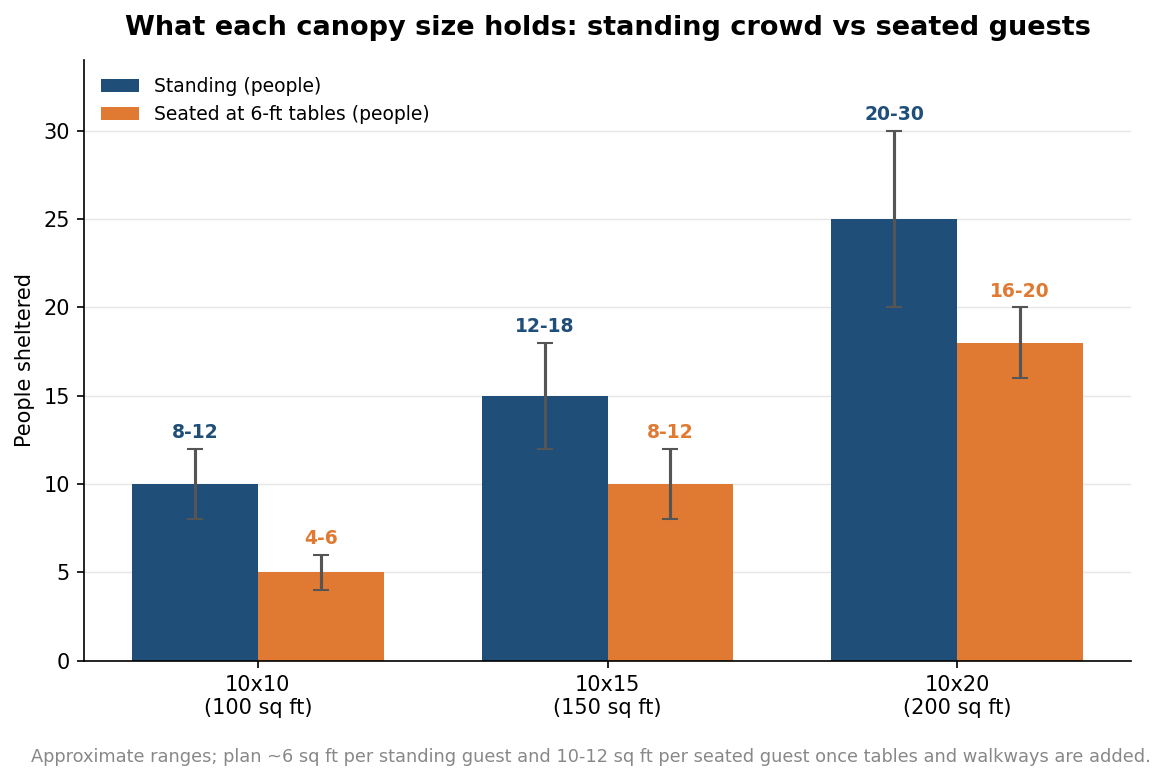
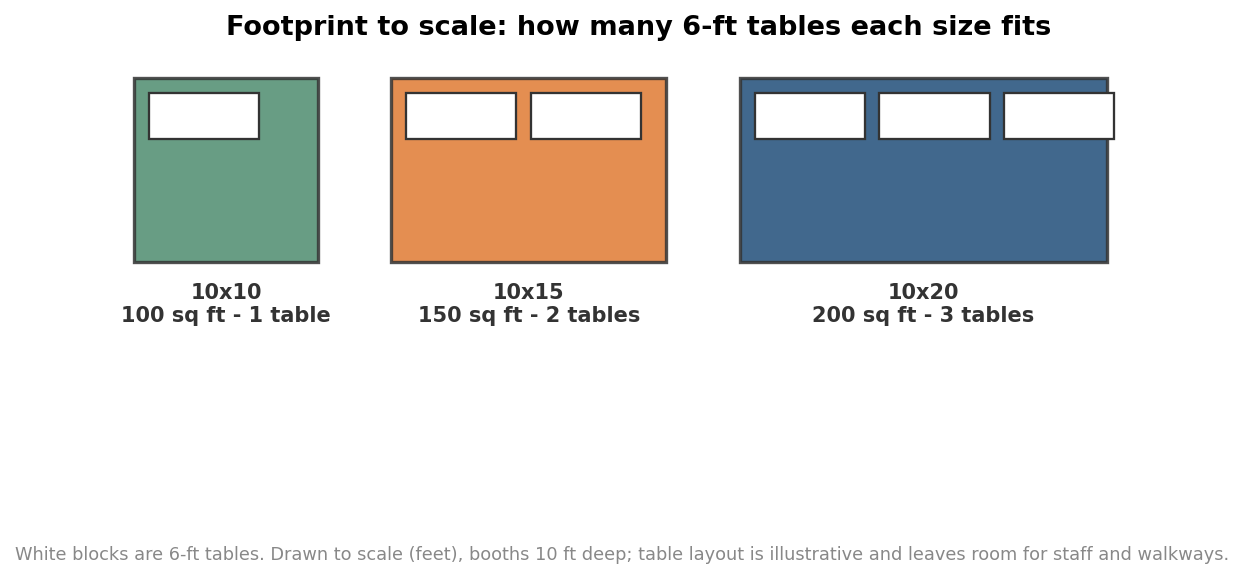
Square footage is abstract until you translate it into what actually goes underneath. A 10×10 comfortably holds a single 6-foot table with a few people working around it, sheltering roughly 8 to 12 standing or 4 to 6 seated once you account for chairs and movement. A 10×15 steps up to about two 6-foot tables, 12 to 18 standing or 8 to 12 seated, which is the sweet spot for a vendor who needs a product table plus a checkout or a demo station. A 10×20 fits three to four 6-foot tables and shelters roughly 20 to 30 people standing or 16 to 20 seated, enough for a full merchandising wall, a seating nook, or a small hospitality area. A useful planning rule is to budget about 6 square feet per standing guest and 10 to 12 per seated guest, because tables, displays, and the aisles people need to move through eat the nominal capacity fast.
Weigh transport and setup before you size up
The larger footprint is not free even after you own it, and the cost shows up every time you load in. A 10×10 is genuinely a one-person, few-minute setup for most pop-up designs, and it drops into the trunk of a normal car. A 10×20 is a different animal: the frame is markedly heavier and longer folded, it wants two people to raise safely without racking the joints, and the packed length may not fit a compact vehicle. Think about who is actually setting up. If your events are staffed by a single person arriving in a sedan, two linked 10×10 canopies can be more practical than one 10×20, giving you the same 200 square feet with lighter individual pieces and the flexibility to deploy them separately. If you always roll in with a van and a two-person crew, the single larger frame is cleaner and faster to skin.
Size drives stability and anchoring
A canopy is a sail, and a bigger canopy is a bigger sail. As the footprint grows, so does the wind load the frame and its anchors have to resist, which means the honest cost of a 10×20 includes noticeably more ballast. A common baseline for a 10×10 on a calm day is at least 40 pounds of weight per leg, roughly 160 pounds total, and manufacturers commonly step that to 50 to 60 pounds per leg on larger canopies, with the guidance to double the weight in genuinely windy conditions. Those figures are a starting point, not a guarantee, and they climb further on hard surfaces where you cannot drive a stake and are relying on weight alone. The practical takeaway for sizing is that a bigger tent obligates you to carry and set more weight at every event, so factor that labor and cargo into the decision rather than discovering it in a gust. For the detail on how to ballast on pavement and what weights to use, work from dedicated anchoring guidance before your first outdoor date.
Choosing your size without regret
Put it together and the pattern is straightforward. Choose a 10×10 when you work a single trade show booth or a standard market stall, set up solo, and need one table and room to stand; it is the most portable, the cheapest to anchor, and the easiest to store. Choose a 10×15 when a single 10×10 leaves you elbowing your own inventory, when you want a product table plus a transaction or demo space, or when a bit more sheltered standing room noticeably improves flow. Choose a 10×20 when you are committing to a double booth, running a team under one roof, or building a hospitality and seating presence, and you have the crew and the vehicle to move it. When you are genuinely torn between one 10×20 and the flexibility to sometimes run smaller, two 10×10 canopies that can stand alone or line up side by side are worth pricing out. Size for the events you actually work most weekends, not the largest one you might do once, and the rest of the specification, frame, fabric, and print, will have a footprint that fits.