Before ordering custom canopy tents, ask every supplier for the frame's leg profile, wall thickness and truss count, how the roof is printed, which walls fit, what ballast per leg is quoted and whether spares are held. Customized Canopy Tents states each of these on the quote and returns a free mockup within 24 hours, so you can compare suppliers on specifications.
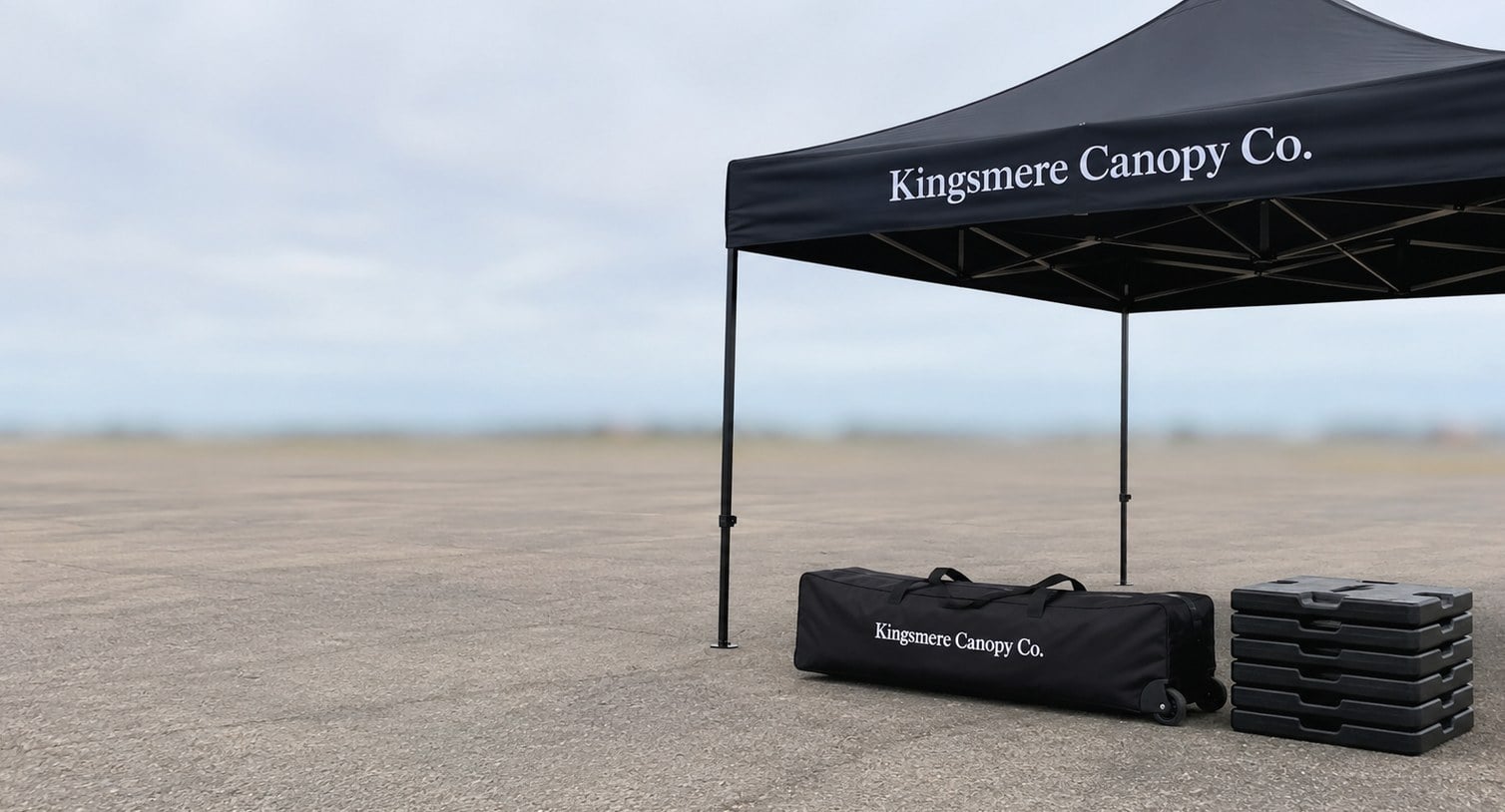
- Ask for leg profile, wall thickness and truss bars per side, not just the footprint
- Ask whether the roof is dye-sublimated so color sits in the fiber
- Ask for ballast quoted as weight per leg, higher when walls are added
- Minimum order of 12; free mockup within 24 hours
- Standard turnaround about 2 weeks, faster with express shipping
Why should you use a checklist when comparing custom canopy tent quotes?
A checklist matters when comparing custom canopy tent quotes because two canopies with the same footprint can be very different products. A quote that only says “10×10 printed canopy” tells you almost nothing about the frame, the roof, the walls or how the tent will be anchored. Those details decide whether the canopy lasts a season or several.
Asking every supplier the same questions turns a comparison of headline footprints into a comparison of specifications. If one supplier answers with leg profile, wall thickness, truss count and ballast per leg while another sends a single line, you have learned something important before spending anything. Customized Canopy Tents writes its quotes around the questions below, and you can use them with any supplier.
Send the list along with your artwork, how often the canopy will go up, the surface it will stand on and whether you plan to add walls. Those three facts let a good supplier recommend the right package instead of the most expensive one.
What frame specifications should a canopy tent supplier state?
A canopy tent supplier should state the leg profile, the aluminum wall thickness, the number of truss bars per side and the corner castings, rather than describing the frame as heavy duty. These four details decide whether the roof stays taut, whether the frame stays square in a gust and how many set-ups it survives.
| Ask about | Why it matters | What a clear answer looks like |
|---|---|---|
| Leg profile | Round legs flex more than hexagonal or octagonal ones | The profile named on the quote |
| Wall thickness | A thin extrusion bends and racks sooner | Thickness quoted, not implied |
| Truss bars per side | Two per side lets a roof sag; three holds it taut | Count per side stated |
| Corner castings | Castings usually break before a leg bends | Reinforced castings named |
| Use frequency | A weekly market stall and a twice-yearly trade show need different frames | Frame picked from how often it goes up |
Customized Canopy Tents quotes these specifications on its pop-up canopy tents and heavy-duty folding frames, and will say when a lighter frame is the right buy for occasional indoor use.
How is the canopy roof printed, and will it fit the frame?
Ask how the canopy roof is printed and whether it is cut for the specific frame. A dye-sublimated roof carries the color in the fiber rather than on the surface, which matters on a canopy because the roof spends its life in direct sun and is folded along the same lines every time. A surface print can crack along exactly those folds.
Fit is the second half of the question. Frames sold under the same footprint are not identical between makers, so a roof cut for one frame can leave the corner pockets short on another. A supplier should ask which frame you have, or supply the frame, so the pockets land on the legs and the roof pulls taut.
- Ask: is the roof dye-sublimated or surface printed?
- Ask: is the valance printed on all four sides?
- Ask: are the corner pockets reinforced and the seams double stitched?
- Ask: can you replace only the roof on a sound frame later?
Customized Canopy Tents answers each of these on its printed roofs and replacement tops page.
What ballast per leg will the supplier quote, with and without walls?
Ask any canopy tent supplier to quote ballast as a stated weight per leg, and to quote it again if you add walls. Most canopies stand on hard surfaces such as car parks, paving, school playgrounds and exhibition floors, where a stake kit does nothing at all. Ballast is the anchor on those surfaces, and a guess is not good enough.
Walls change the answer. An open canopy lets air pass through, while a walled canopy behaves like a solid structure, so the same breeze pushes harder on it. A careful supplier raises the quoted weight per leg when sidewalls or half walls are part of the order instead of leaving you to discover the problem on a windy morning.
- Stacking plates suit a permanent pitch where the canopy goes up in the same place.
- Fillable sand or water bags suit touring stalls because they weigh nothing until filled on site.
- Ratchet strap kits help secure the load to the leg.
See the weight plates and anchoring kits page and the printed sidewalls and half walls page for how Customized Canopy Tents quotes both together.
Is the canopy quoted as a complete package or as separate parts?
Ask whether the custom canopy tent is quoted as a complete package with frame, printed roof, walls, ballast and bag, or as separate line items. Buyers who order a printed canopy on its own often end up with no weights, which is one of the most common ways a first order goes wrong. A package built around how you use the canopy closes that gap.
The questions a good supplier asks back are simple: how often does the canopy go up, what surface does it stand on and will it be walled? Customized Canopy Tents uses those three answers to pick the frame gauge, the ballast and the wall set for its market and trade show packages, and adds a wheeled bag with a drying instruction.
A package also makes quotes easier to compare. When two suppliers quote the same frame specification, roof print, walls and ballast, the difference between them is real. When one quote leaves out the ballast or the bag, the cheaper-looking number may not be the cheaper canopy once the missing parts are added.
What happens with spares, reorders, proofs and timing?
Ask what support comes after delivery: whether spare legs and corner castings are held for the frame, whether your artwork and specification stay on file for reorders, and how the proof and timeline work before production. These answers matter most for markets, hire companies, schools and brands running several canopies over several seasons.
Customized Canopy Tents holds spares for the frames it sells, keeps artwork and specification on file for reorders and offers a free vector redraw, a free mockup within 24 hours and unlimited free revisions. You pay nothing until you approve the design. The product pages list a minimum order of 12, and standard turnaround is about 2 weeks, with faster turnaround available with express shipping.
- Are spare legs and castings held for this exact frame?
- Will a reorder use the same artwork and color as the first run?
- Is the mockup free, and are revisions unlimited?
- What is the minimum order for this style?
- How long from approval to delivery, and is express available?
Send your artwork, use frequency, surface and wall plan through the custom quote page and compare the reply against this checklist.
Frequently asked questions
Why do some canopy tent quotes leave out the frame specification?
Canopy tent quotes sometimes describe only the footprint because two frames of the same size can look identical in a photo while differing in leg profile, wall thickness and truss count. Leaving those out makes a lighter frame harder to spot. Customized Canopy Tents quotes the profile, thickness and truss bars per side so buyers can compare frames fairly.
Should I ask a canopy tent supplier how often their frame can be set up?
Canopy tent frames should be matched to how often they go up, so tell any supplier your expected use, whether a weekly market or a few events a year. Customized Canopy Tents picks the frame from that frequency and will recommend a lighter frame when it genuinely suits occasional or indoor use, rather than quoting the heaviest option.
Is heavy duty a meaningful description on a canopy tent quote?
Canopy tent quotes that say heavy duty without numbers are not giving a specification. The useful details are the leg profile, the aluminum wall thickness, the truss bars per side and the corner castings. Customized Canopy Tents does not use heavy duty as a specification on its quotes and states those details instead, so they can be compared with any supplier.
What part of a canopy tent frame usually fails first?
Canopy tent frames usually fail at the corner castings before a leg bends, which is why the castings belong on any checklist. Ask whether they are reinforced and whether spares are held. Customized Canopy Tents quotes the castings alongside the extrusion and holds spare legs and castings for the frames it sells.
Will a new printed canopy roof fit a frame from another maker?
Canopy roofs only fit well when cut for the specific frame, because frames with the same footprint differ between makers and corner pockets can land short. Tell the supplier exactly which frame you have. Customized Canopy Tents asks for frame details before cutting a replacement top, or supplies the frame, so the roof pulls taut.
Do custom canopy sidewalls need extra weights?
Custom canopy sidewalls need extra ballast, because a walled canopy stops air passing through and the same breeze pushes harder on the structure. Ask for the weight per leg quoted with the walls included. Customized Canopy Tents quotes ballast together with the walls so the anchoring matches the setup you will actually use.
Should canopy tent ballast be plates or fillable bags?
Canopy tent ballast choice depends on how the canopy moves. Stacking plates suit a permanent pitch at a market or forecourt, while fillable sand or water bags suit touring stalls because they weigh nothing until filled on site. Customized Canopy Tents recommends one or the other based on how you transport and set up the canopy.
Which three facts decide the right custom canopy package?
Custom canopy packages are decided by three facts: how often the canopy goes up, what surface it stands on and whether it will be walled. Those answers pick the frame gauge, the ballast per leg and the wall set. Customized Canopy Tents builds market and trade show package quotes from them, and a supplier who never asks is guessing.
Can a business reorder matching custom canopy tents a year later?
Custom canopy tents can be reordered to match when the supplier keeps the artwork and specification on file. Ask about this before the first order. Customized Canopy Tents keeps both on file for reorders, so a brand adding canopies for a new location or a club replacing a worn roof gets a consistent look.
Should a custom canopy tent quote include a carry bag?
Custom canopy tent quotes should include a carry bag, because the bag is what protects the frame and roof between events and survives being dragged across a car park. Customized Canopy Tents supplies a wheeled bag with a drying instruction, since packing a canopy away wet is one of the quickest ways to damage the printed roof.
How do I compare two custom canopy tent quotes that differ a lot?
Custom canopy tent quotes that differ widely usually differ in the frame, the roof print or what is included. Line them up on leg profile, wall thickness, truss bars, print method, walls, ballast and bag. Customized Canopy Tents states each item on its quote, which makes gaps in another quote easy to see.
Get a free mockup for your canopy tents
Send your logo or idea and the quantity you have in mind. Customized Canopy Tents returns a free mockup within 24 hours, you approve the design before anything is produced, and standard turnaround is about two weeks with faster options available. Get a custom quote.